
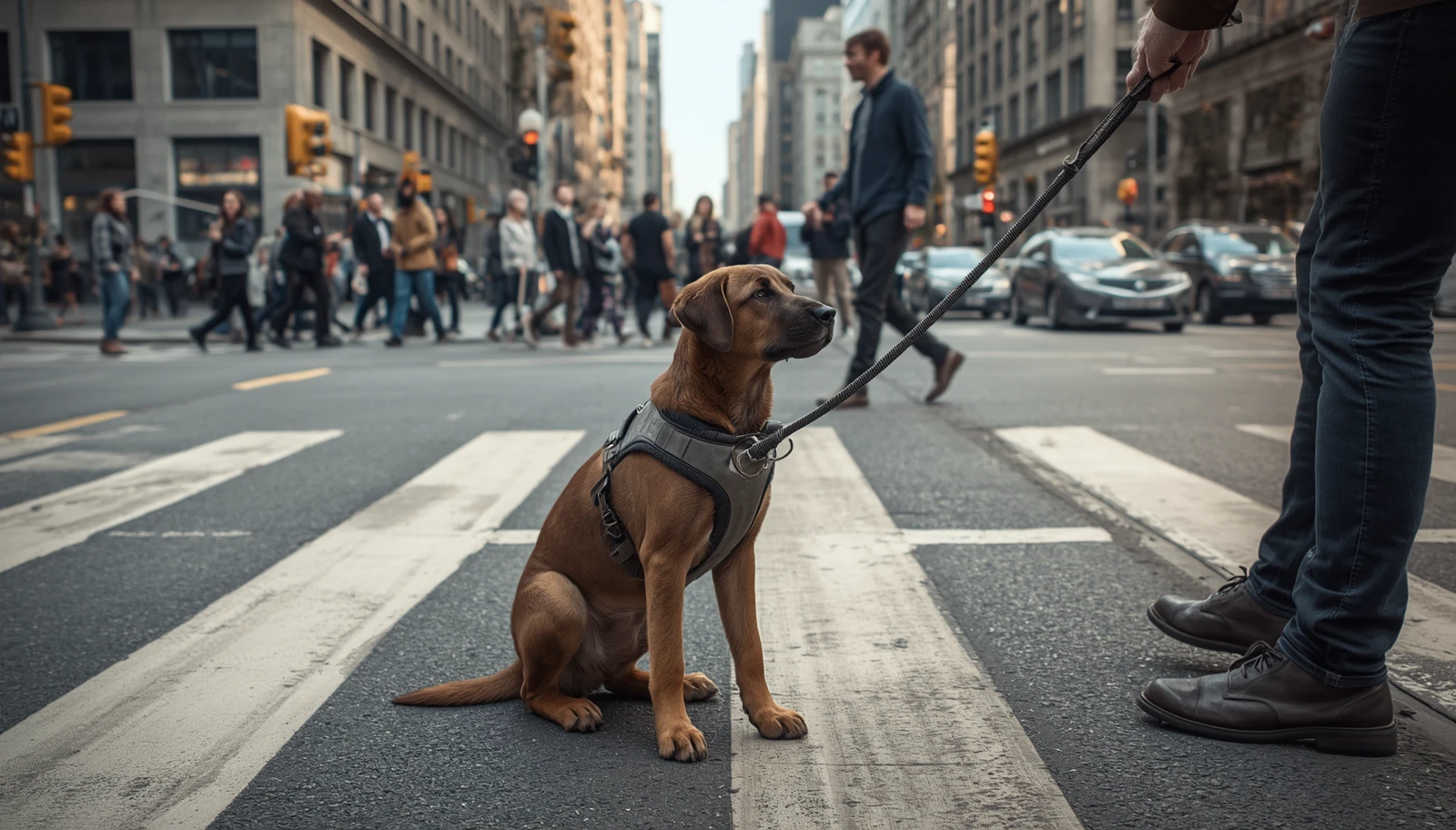
Busy crosswalks can turn an ordinary puppy walk into a valuable lesson in focus, patience, and awareness. Cars, motorcycles, bicycles, pedestrians, horns, and sudden movements can quickly challenge a young dog’s attention. What seems like a simple street crossing can become an important opportunity to build calmer and more reliable behavior in public.
Learning Protection Puppy at Crosswalk skills means teaching a puppy to remain connected with the handler while processing unfamiliar sights, sounds, and movement. The goal is not to force the puppy through stressful situations, but to develop confidence, impulse control, and reliable responses through gradual practice. If your puppy can stay focused on a quiet street, how will that behavior hold up when the same walk suddenly becomes crowded?
Facing Busy Crosswalks With My Puppy
For personal protection dogs, dependable public behavior is particularly important because they must remain responsive around ordinary distractions. A protection-oriented puppy should learn to notice people, vehicles, and sounds without automatically reacting to everything happening nearby. That balance between awareness and control starts with manageable experiences and consistent guidance.
A busy intersection can reveal weaknesses that remain hidden during quiet walks. Instead of treating hesitation or distraction as failure, consider what your puppy is communicating. Is the traffic too close? Are there too many pedestrians? Or has the puppy simply reached the limit of its current experience?
New Sights Caused Hesitation
Buses, motorcycles, bicycles, umbrellas, signs, and unfamiliar pedestrians can easily capture a puppy’s attention. Hesitation does not necessarily mean poor training. It may simply show that the environment is more challenging than the puppy is ready to handle.
Give the puppy enough space to observe safely, then reward calm attention toward the handler. Gradual exposure helps unfamiliar sights become predictable without creating unnecessary pressure.
Traffic Sounds Broke Focus
Traffic creates a constant stream of engines, horns, brakes, and sirens. Even a puppy that appears comfortable may suddenly lose concentration when a loud vehicle passes nearby.
Begin with quieter streets before introducing stronger traffic distractions. Michele Miller, CPDT-KA, explains, “Engagement is a skill, and we need to work on that.” Teaching voluntary attention gives the puppy a useful response when environmental noise becomes distracting.
Crowds Increased Distractions
Pedestrian traffic adds another challenge because people rarely move predictably. Someone may stop suddenly, approach closely, carry a large object, or pass from behind.
This is where puppy socialization becomes valuable. The objective is not to make the puppy ignore people, but to teach it to notice the surroundings and then return attention to the handler.
How I Trained At Every Crossing
Once the puppy could remain reasonably calm around everyday distractions, each crossing became a controlled training opportunity. The difficulty was increased gradually rather than immediately testing the puppy at the busiest intersection available.
A predictable routine also made the experience easier to understand. Stop, wait, check in, reward, and move forward only when the situation is safe. This structure supports reward-based dog training while helping the puppy understand what behavior is expected.
Starting With Quiet Crosswalks
Quiet crosswalks provide a manageable starting point because they reduce competing distractions. The puppy can learn where to stop, how to remain beside the handler, and when to move forward.
When these behaviors become reliable, introduce moderately busier crossings. Gradual progression supports traffic desensitization while keeping the puppy within a manageable level of stimulation.
Practicing Stop And Wait
Stopping at the curb teaches an important lesson: reaching the road does not automatically mean moving forward. A simple sequence of walk, stop, wait, check in, and cross creates a predictable behavioral pattern.
This also develops impulse control training. Practice the sequence in quiet areas first, then gradually transfer the skill to locations with more traffic and pedestrians.
Rewarding Calm Responses
Reward the behaviors that make crossing safer and more controlled. Calm waiting, a loose leash, eye contact, and voluntary attention can all be reinforced appropriately.
A small treat or verbal praise can communicate that calm behavior is valuable. Reward-based methods also provide a practical foundation for puppy training around traffic without relying on unnecessary pressure.
What Changed After Regular Practice
Regular practice gradually transformed crosswalks from unpredictable challenges into familiar routines. The puppy did not need to stop noticing traffic or crowds. Instead, it became better at observing distractions without immediately reacting to them.
That distinction matters because effective training does not eliminate curiosity. It develops handler engagement, allowing the puppy to remain responsive even when something interesting happens nearby. Each successful crossing becomes preparation for the next level of difficulty.
Crossing Became More Controlled
The puppy began approaching the curb with greater composure instead of anticipating movement. Waiting became part of the routine, while the handler’s cues became easier to understand.
This created a stronger foundation for safe leash walking, where practical control matters more than rigid obedience.
Focus Improved Around Traffic
Repeated exposure at an appropriate difficulty level helped traffic become less novel. Vehicles could still attract attention, but the puppy became increasingly capable of returning focus to the handler.
This demonstrates an important principle of impulse control for puppies: distractions do not need to disappear before appropriate behavior can occur.
Daily Walks Felt Safer
The most noticeable improvement was predictability. Instead of depending entirely on physical restraint when something unexpected appeared, training created clearer communication between puppy and handler.
For a protection-oriented dog, that predictability matters. Public behavior should remain composed around pedestrians, vehicles, animals, and unfamiliar surroundings. Jan Reisen of the American Kennel Club describes communication between dogs and handlers as a “two-way street,” emphasizing that handlers need to understand their dogs as well as teach reliable responses.
Build Safer Crosswalk Habits Together
Ready to build safer Protection Puppy at Crosswalk habits? Start today with calm, consistent practice and help your puppy develop better focus, confidence, and control around busy streets.